
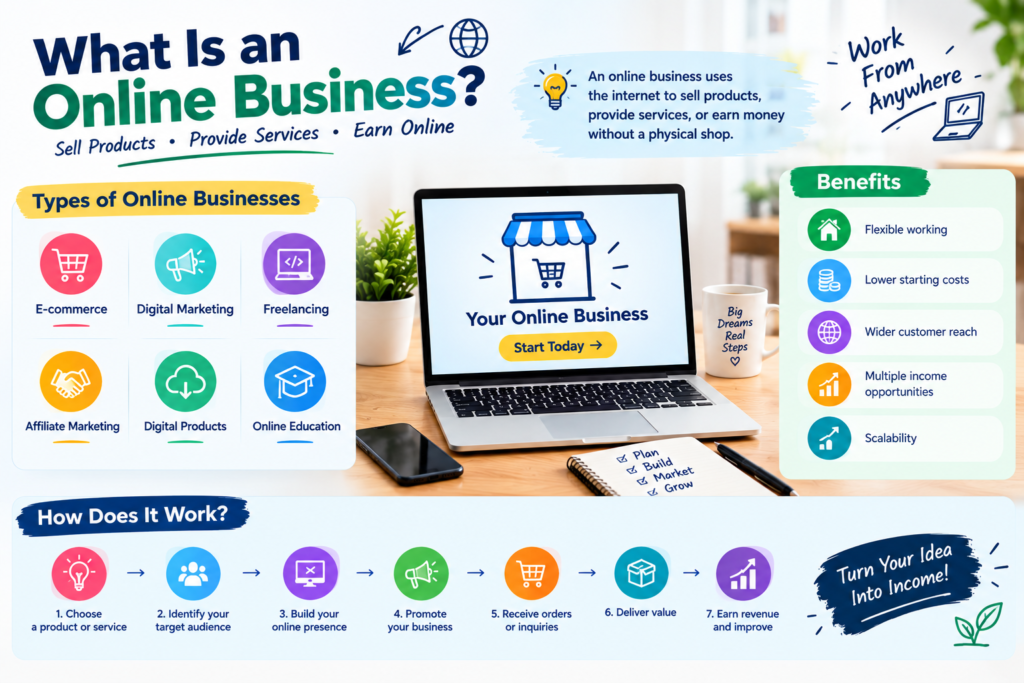
The global commerce landscape has shifted irreversibly from traditional brick-and-mortar storefronts toward digital platforms. But for aspiring entrepreneurs and professionals exploring this space, a foundational question often arises: what is an online business, and how does it actually generate sustainable profit in today’s economy?
Quick Answer:
What is an online business? An online business (also known as an e-business or internet company) is any commercial entity, venture, or individual service provider that conducts its primary operations—including product display, marketing, customer communication, sales transactions, and service fulfillment—partially or entirely across the internet.
Unlike physical businesses restricted by geographic location and rigid operating hours, an internet business operates 24 hours a day, 7 days a week, serving customers across different cities, states, and time zones. In this in-depth guide, we unpack modern digital commerce, examine how online enterprises function behind the scenes, outline the seven most lucrative business models, and provide practical steps to launch your digital venture in 2026.
Table of Contents
- Core Definition & Mechanics of an Online Business
- How an Online Business Works: The 4-Stage Operational Engine
- 7 Most Profitable Online Business Models in 2026
- Major Benefits of Running an Online Business Over Physical Stores
- Common Pitfalls to Avoid When Launching Online
- Frequently Asked Questions (FAQ)
- Conclusion and Next Steps
What Is an Online Business? Definition and Core Mechanics
To fully grasp what is an online business, one must recognize that digital infrastructure powers the entire customer transaction lifecycle. According to the authoritative reference on Electronic Business on Wikipedia and business insights from Forbes Business Advisor, online commerce integrates digital supply chains, automated customer management, cloud payment processing, and electronic marketing.
In simple terms, an online business can be run with just a laptop and reliable high-speed internet. You do not need expensive commercial rent, physical showroom displays, or dozens of in-person retail clerks. Instead, your digital infrastructure—anchored by your website, social profiles, and marketing funnels—handles customer acquisition and order processing automatically.
If you are ready to take action and launch your own company, be sure to read our detailed step-by-step roadmap on how to start an online business in 2026.
How an Online Business Works: The 4-Stage Operational Engine
Every successful digital company relies on four interconnected operational stages:
- Audience Acquisition (Traffic): Attracting prospective customers to your digital presence through organic search (SEO), paid search ads, social media content, or referral links.
- Engagement & Value Proposition (The Front-End): Using a professional, high-speed website to showcase product benefits, customer reviews, and clear calls to action. Explore our custom Website Design and Development services to see how high-converting web stores are constructed.
- Frictionless Transaction (Payment Gateway): Allowing clients to pay securely via credit cards, UPI, net banking, or digital wallets like Stripe and Razorpay.
- Fulfillment & Retention (The Back-End): Delivering the purchased physical goods or digital services promptly, followed by automated email nurturing to build customer loyalty.
7 Most Profitable Online Business Models in 2026
| Business Model | How It Makes Money | Initial Startup Cost | Scalability Rating |
|---|---|---|---|
| 1. E-Commerce Store | Selling physical goods via direct-to-consumer websites | ₹35,000 – ₹1,50,000 | Very High |
| 2. Digital Agency / Freelancing | Providing B2B services (SEO, Ads, Web Development) | ₹10,000 – ₹25,000 | High |
| 3. Software as a Service (SaaS) | Recurring monthly or annual software subscriptions | ₹50,000 – ₹3,00,000+ | Extremely High |
| 4. Affiliate Marketing & Niche Media | Earning commissions recommending third-party products | ₹8,000 – ₹20,000 | Very High |
| 5. Online Courses & Coaching | Selling educational curriculums and mentoring sessions | ₹15,000 – ₹40,000 | High |
| 6. Dropshipping & Print-on-Demand | Selling products fulfilled directly by third-party suppliers | ₹20,000 – ₹50,000 | Moderate to High |
| 7. Paid Communities & Newsletters | Monthly membership fees for exclusive industry insights | ₹5,000 – ₹15,000 | High |
Major Benefits of Running an Online Business Over Physical Stores
- Significantly Lower Startup & Overhead Costs: You avoid expensive security deposits, showroom lease agreements, electricity charges, and extensive floor staff.
- Global Market Reach: A physical store in Delhi only serves individuals walking past the street; a digital business can sell goods to buyers in Mumbai, London, Dubai, or New York simultaneously.
- Automated Round-the-Clock Sales: Your online store continues processing customer orders while you sleep, travel, or focus on strategic expansion.
- Data-Driven Decision Making: Every click, impression, and bounce can be measured in real-time through analytics, enabling you to optimize your return on advertising spend (ROAS).
Common Pitfalls to Avoid When Launching Online
While an online business offers immense flexibility, over 70% of beginner businesses struggle due to common mistakes:
- Ignoring Search Engine Optimization: Relying exclusively on paid ads eats away your profits. Investing early in Search Engine Optimization services establishes sustainable, free organic customer traffic.
- Poor Mobile User Experience: More than 75% of web visitors browse on smartphones. If your checkout page is not mobile-responsive, conversions plummet.
- Lack of Real Differentiation: Merely copying competitors without a unique value proposition fails to capture market attention. Focus on superior customer service, faster delivery, or niche-specific customization.
Frequently Asked Questions (FAQ)
Is an online business suitable for beginners with no experience?
Yes. Digital marketing agencies, freelance consulting, and content publishing require zero specialized engineering skills. Modern no-code website builders and AI tools allow anyone to launch and manage an online enterprise.
How long does it take for an online business to become profitable?
Service-based businesses can become profitable within their first 30 to 60 days by landing initial client retainers. E-commerce and media platforms typically take 4 to 8 months to reach consistent profitability as SEO and brand recognition mature.
Do I need an office to run an online business?
No. The vast majority of online entrepreneurs operate entirely from home or use flexible co-working spaces, hiring remote freelancers as needed.
Conclusion and Next Steps
Now that you clearly understand how digital business models generate revenue and how their commercial models function, the next logical step is taking purposeful action. Choose a proven business model that matches your skillset, build a fast conversion website, and implement a consistent customer acquisition strategy.
Need expert support building your online store, scaling Google rankings, or running profitable ad campaigns? Explore our Website Design and SEO services, or reach out to Promodigi today for a tailored growth strategy.

Pingback: How to Start an Online Business in 2026: 9 Practical Steps to Launch - Promodigi | Digital Marketing & Web Design Agency