
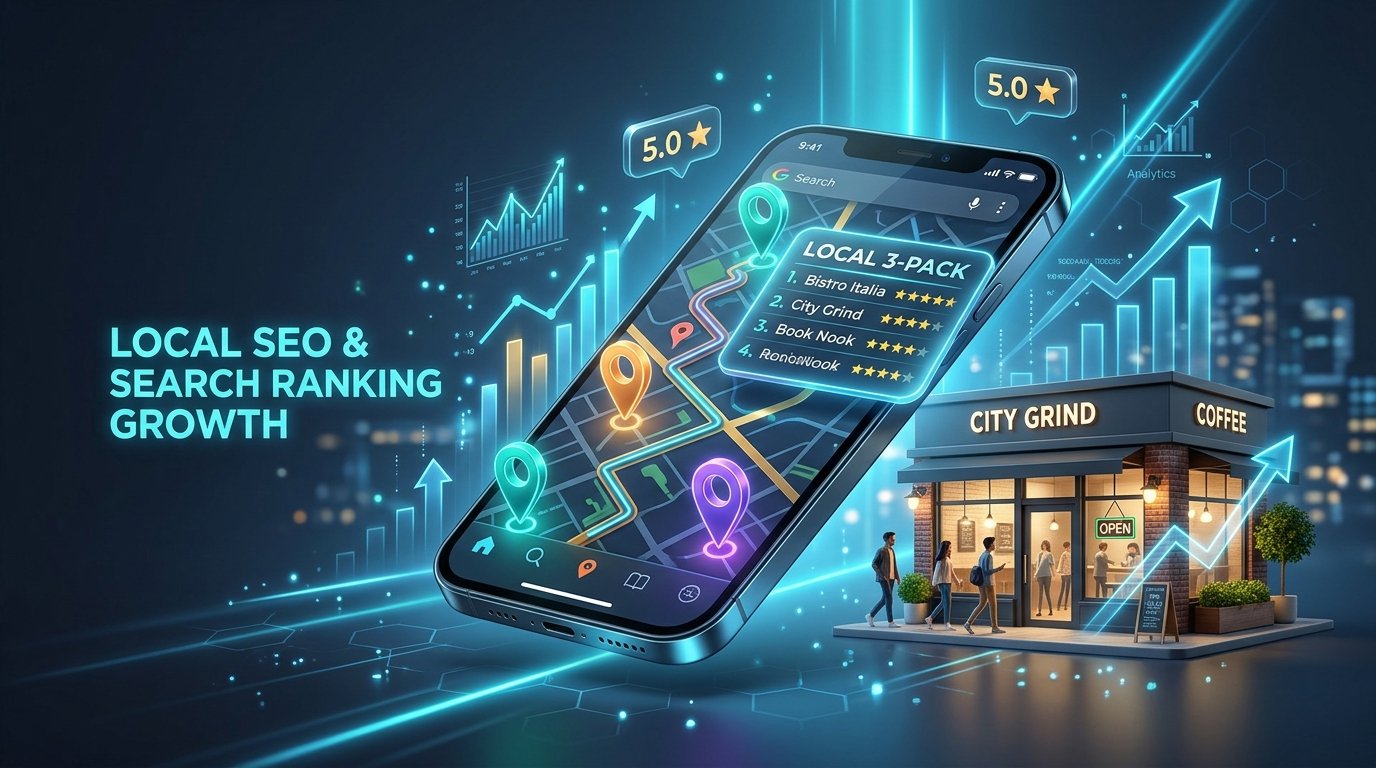
Understanding what is local SEO and how does it work is critical for any company seeking to attract customers in its immediate geographical service area. When consumers search for nearby services—whether it is a digital marketing agency in Delhi NCR, a dental clinic in South Extension, or a boutique in Connaught Place—Google displays a specialized local search result known as the Local 3-Pack.
Quick Answer for Business Owners:
What is local SEO and how does it work? Local Search Engine Optimization (Local SEO) is the strategic process of optimizing your business’s online footprint—primarily your Google Business Profile (GBP), customer reviews, local citations, and website content—to rank at the top of Google Maps and local search results when people search for services near them.
If your company fails to appear in these top local map positions, you are forfeiting high-intent, ready-to-buy consumers directly to neighboring competitors. In this in-depth guide, we demystify what is local SEO and how does it work, breaking down nine proven strategies to optimize your Google Business Profile, generate authoritative local citations, and dominate Google Maps rankings in 2026.
Table of Contents
- What Is Local SEO and How Does It Work in Practice?
- The 3 Core Pillars of Google Local Search Ranking
- Strategy 1: Fully Optimize Your Google Business Profile
- Strategy 2: Establish Flawless NAP Consistency Across the Web
- Strategy 3: Build an Automated Customer Review Generation Engine
- Strategy 4: Target Geo-Specific Long-Tail Keywords
- Strategy 5: Build High-Converting Location Landing Pages
- Strategy 6: Implement LocalBusiness Structured Data Schema
- Strategy 7: Earn Authoritative Local Backlinks & Citations
- Strategy 8: Optimize for Mobile “Near Me” Voice & Micro-Moments
- Strategy 9: Monitor Local Pack Rankings & Call Conversions
- Traditional Organic SEO vs Local SEO Comparison
- Frequently Asked Questions (FAQ)
What Is Local SEO and How Does It Work in Practice?
Local Search Engine Optimization (Local SEO) is the strategic practice of optimizing a business’s online presence to elevate its organic visibility in location-based search queries on Google Search and Google Maps. Unlike broad global SEO that targets international audiences, local SEO focuses entirely on prospective clients located within a defined radius.
To grasp what is local SEO and how does it work, consider how search behavior shifts when geography is involved. When a user searches for “best digital marketing company” while located in Delhi, Google’s algorithms automatically infer geographical intent using IP addresses, Wi-Fi triangulation, and GPS location. Instead of displaying only standard website links, Google immediately displays Google Map listings alongside operational hours, star ratings, phone numbers, and driving directions.
According to official documentation published by Google Business Profile Help, businesses that maintain complete, verified profiles are twice as likely to earn consumer trust and capture immediate store visits.
For small businesses aiming for steady inbound calls and revenue growth, implementing specialized Search Engine Optimization (SEO) services designed for regional search is often the highest-ROI investment available.
The 3 Core Pillars of Google Local Search Ranking
Google’s proprietary local search algorithm relies on three fundamental ranking parameters:
- Relevance: How accurately your business profile and website match the user’s specific query. Detailed category selections and keyword-optimized descriptions directly enhance relevance.
- Distance (Proximity): How far your verified physical address or service perimeter is located from the user’s current search location.
- Prominence: How reputable and well-known your business is both offline and online. This is influenced by review volume, review sentiment, local media mentions, and overall domain authority.
Strategy 1: Fully Optimize Your Google Business Profile
Your Google Business Profile (formerly Google My Business) is the core operational cornerstone of local search. Merely claiming the listing is insufficient; complete optimization is required to outrank established competitors.
Follow these optimization requirements:
- Accurate Primary Category: Select the exact primary category that reflects your core revenue driver (e.g., “Internet Marketing Service” or “Marketing Agency”).
- High-Resolution Photography: Upload crisp interior, exterior, team, and client collaboration photos. Geotagged images establish geographical context.
- Weekly GBP Updates: Publish weekly Google Posts highlighting recent case studies, promotional offers, or educational tips.
- Complete Attributes: Fill out appointment URLs, operational hours, accepted payment methods, and amenity tags.
Strategy 2: Establish Flawless NAP Consistency Across the Web
NAP stands for Name, Address, and Phone Number. Google’s crawlers cross-reference third-party directories to verify whether your business is authentic and active.
If your address appears as “Suite 401, Sector 18, Noida” on your website but is listed as “401, Sec-18, Noida, UP” on Justdial or IndiaMart, search crawlers perceive this ambiguity as a risk factor, diminishing your local prominence score. Ensure exact typographical uniformity across all business directories, social platforms, and website footers.
Strategy 3: Build an Automated Customer Review Generation Engine
Customer reviews directly dictate click-through rates and local pack placement. Research indicates that 88% of consumers trust online reviews as much as personal recommendations.
To scale review acquisition:
- Generate a custom short review link inside your GBP dashboard.
- Send automated WhatsApp or SMS review requests within 24 hours of successful service delivery or project completion.
- Always respond professionally to both positive and negative reviews, incorporating your primary service keywords naturally into the replies.
Strategy 4: Target Geo-Specific Long-Tail Keywords
Instead of competing exclusively for highly saturated broad terms, optimize for hyper-local modifiers that signal strong purchasing intent. For instance, rather than targeting only “marketing services”, optimize your landing pages for terms like “digital marketing services in Delhi” or “local SEO services for small business”.
Review our in-depth breakdown on affordable digital marketing services Delhi for small business to see how strategic local pricing and targeted keyword funnels drive high-ticket clients.
Strategy 5: Build High-Converting Location Landing Pages
If your agency or business serves multiple areas across a metropolitan region, create dedicated location pages for each key market (e.g., Delhi, Gurgaon, Noida, Faridabad).
Each dedicated location page must contain:
- A localized Google Map embed pointing to your primary location.
- Localized case studies and client feedback from that specific territory.
- Neighborhood references, landmark directions, and local business hours.
- Direct internal links to your agency’s core services on Promodigi Digital Agency.
Strategy 6: Implement LocalBusiness Structured Data Schema
Structured data markup translates your website’s content into machine-readable code that Google search bots comprehend instantly. Implementing the LocalBusiness schema on your homepage and contact page confirms your geographical coordinates, business hours, price range, and accepted payment methods.
Refer to the authoritative technical specifications on Schema.org LocalBusiness to configure structured JSON-LD scripts properly.
Strategy 7: Earn Authoritative Local Backlinks & Citations
While generic backlinks from global blogs carry general authority, hyper-local backlinks from regional newspapers, local chamber of commerce directories, and community sponsorships provide powerful geographical relevance signals. Sponsor local business events in Delhi NCR or participate in business associations to secure high-trust local citations.
Strategy 8: Optimize for Mobile “Near Me” Voice & Micro-Moments
Mobile device queries containing “near me now” or “where to buy [service] near me” have grown by over 200% across recent years. Ensure your site loads in under 1.5 seconds, features a click-to-call phone button fixed in the header, and includes conversational FAQ answers to capture voice assistant inquiries via Google Assistant and Siri.
Strategy 9: Monitor Local Pack Rankings & Call Conversions
Track your local visibility using geo-grid rank trackers that demonstrate where your profile ranks block-by-block across your target city. Combine this with GBP Performance insights to measure:
- Direct Phone Calls: Inquiries initiated straight from the Google Maps interface.
- Direction Requests: Users seeking driving routes to your office.
- Website Clicks: High-intent visitors navigating to your landing pages.
Traditional Organic SEO vs Local SEO Comparison
| Feature | Traditional Organic SEO | Local Search Engine Optimization |
|---|---|---|
| Target Audience | National or global users searching for general information | Local residents searching for nearby services or stores |
| Primary Ranking Asset | Website pages, blog articles, and domain backlinks | Google Business Profile, NAP citations, and Google Maps |
| Key Ranking Factors | Content quality, technical SEO, high-DA backlinks | Relevance, Proximity (Distance), and GBP Prominence |
| Search Placement | Standard 10 blue organic search results | Google Local 3-Pack, Google Maps, and localized search results |
| Conversion Intent | Informational, research, and long-term evaluation | Immediate transactional intent (Calls, visits, bookings) |
Frequently Asked Questions (FAQ)
What is local SEO and how does it work for service-area businesses?
Local SEO optimizes your online presence so search engines match your services to consumers searching in your immediate geographical area. For service-area businesses without a walk-in storefront (such as mobile repair or on-site marketing consultants), you can specify your operational service radiuses while keeping your residential address private on Google Business Profile.
How long does local SEO take to rank on Google Maps?
A well-optimized Google Business Profile can achieve top 3 local pack rankings within 30 to 90 days for moderate-competition search terms. In hyper-competitive metro areas like Delhi NCR, consistent review generation, local citations, and technical site optimization over 3 to 6 months are typically required.
Is a Google Business Profile completely free?
Yes. Creating, claiming, and managing a Google Business Profile is 100% free through Google. Beware of third-party telemarketing scams claiming you must pay an annual renewal fee to keep your Google Maps listing active.
Why is my business not showing up on Google Maps?
Common reasons include an unverified profile, incorrect primary business category, severe NAP inconsistencies across directories, suspension due to policy violations, or simply having significantly fewer customer reviews than established competitors in your immediate vicinity.
Want to Dominate Google Maps in Delhi NCR?
At Promodigi, we engineer tailored Local SEO campaigns that position your company in the coveted Google Local 3-Pack. Stop losing local leads to nearby competitors. Speak with our local search specialists today.
